Algiers
The Myth of SisyphusAlgiers is not merely a setting but a complete mode of being. Open to the sky, the sea, and the naked evidence of the body, it offers an earthly abundance so immediate that it leaves little room for education, metaphysical hope, or escape. Its decisive significance lies in this paradox: Algiers nourishes its inhabitants with beauty while refusing to protect them from time, poverty, injustice, and death.
An Open City of Sea and Light
Algiers differs from enclosed European cities such as Paris, Prague, and Florence because it opens outward toward the sky. Its sea appears at the end of every street, while sunlight becomes almost a form of possession that allows people to measure what they have. The city’s pleasures are public and elemental rather than secretive: the bay, the brightness, the harbor, and the bodily life gathered around them make the world immediately available to the senses.
That openness is also a wound. Algiers gives itself without reserve, but its generosity offers no lesson and no promise. A person who wishes to learn, improve, or be spiritually instructed finds no consoling program in the landscape. The country gives abundantly, yet its joys are without remedy and without hope; it demands lucidity in place of faith. The same natural richness that produces splendor therefore coincides with extreme destitution, and the city’s beauty becomes most affecting when seen alongside its poorest inhabitants.
Youth, the Body, and the Present
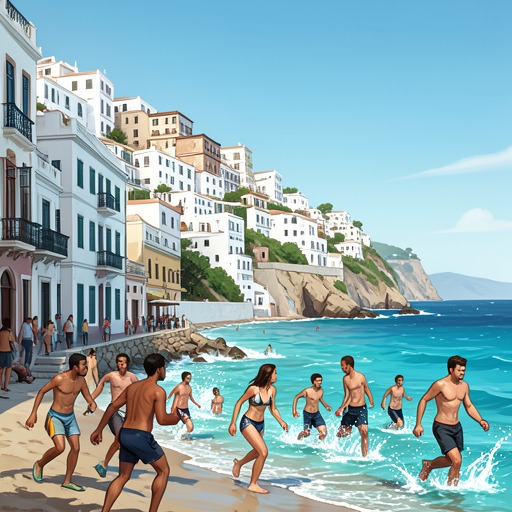
Algiers organizes life around youth and physical vitality. During their early years, men find a way of living proportionate to their beauty: the bay, the sunlit terraces, the sports stadiums, the flowers, and the women moving through the city provide occasions for triumph. The city’s pleasures are not reserved for contemplation; they are enacted through swimming, sunbathing, sport, and the daily exposure of the body to light.
Swimming in Algiers is described not as an errand but as an indulgence. People enter the harbor and rest on buoys, while a pretty girl sunning herself may become the object of a shouted joke comparing her to a seagull. In winter, many young men continue to undress at noon for a frugal meal in the sun. Their comfort in sunlight is not presented as a doctrine borrowed from nudism but as an untheorized habit, a bodily ease that precedes intellectual explanation.
This beach culture also gives the body a history. Young men running along Mediterranean beaches repeat the gestures of the athletes of Delos, undoing two thousand years of attempts to make Greek nakedness decent, to diminish flesh, and to complicate dress. The gradual movement of skin from white through golden and tanned tones toward tobacco color becomes a visible record of the body’s capacity for transformation. Against the white cubes of the Kasbah and the harbor, physical existence appears not as an embarrassment to overcome but as an experience with its own life, psychology, progress, and limits.
Yet the city’s celebration of youth contains a severe temporal judgment. Later come the downhill slope and obscurity. Those who have wagered on the flesh know that they will lose, but Algiers provides little refuge once youth has passed. Elsewhere, terraces, cloisters, or hills may allow a person to flee humanity gently; in Algiers, the heat, blood, and young bodies offer no such retreat. Old men in the cafes of Belcourt and Bab-el-Oued listen to the boasts of young men with plastered hair, witnesses to a city whose present vitality makes aging especially visible.
December Exile and the Memory of Summer
Algiers changes when the season changes. In summer, the city’s poor descend toward the harbor to share the warmth of the water and the sight of women’s brown bodies, then return in the evening to rooms defined by oilcloth and a kerosene lamp. The city’s abundance and poverty thus occupy the same daily circuit: sensual wealth is gathered at the water, while ordinary life closes again around its simplest material conditions.
A December visit reverses the familiar image. After five days of ceaseless rain, the sea itself seems wet and motionless beneath the gray sky, while the white walls drip and the boulevards shine. The visitor has fled Europe’s winter and its “winter of faces,” expecting the city of summers, but finds Algiers emptied of laughter and filled with bent, shining backs. In the dim cafes, familiar faces reveal the passage of age even when their names cannot be recalled.
The rain-bound city awakens the desire to return to Tipasa, where more than twenty years earlier the visitor had wandered among ruins, breathed wormwood, warmed himself against stones, and discovered small roses. The remembered landscape represents a freedom associated with youth, but the return is recognized as dangerous: the past cannot simply be restored by revisiting its sites. Algiers therefore holds both the remembered promise of summer and the knowledge that time has altered the person who remembers it.
Mythless Material Truth
Algiers is imagined as a place between the sky and faces turned toward it, with no secure foundation for mythology, literature, ethics, or religion beyond stones, flesh, stars, and truths that the hand can touch. Its power comes from refusing supernatural compensation. There is no promise of a higher happiness or an eternity outside the movement of days; the city’s relative, physical belongings are the truths capable of stirring the heart.
This material world does not produce simple optimism. The people associated with Algiers are described as having no past or tradition, yet not as lacking poetry. Their poetry is harsh, carnal, and distant from tenderness, shaped by the sky rather than by inherited consolation. They live wholly in the present, having placed their possessions on earth and thereby remaining exposed to death. Their haste, their horror of stability, and their disregard for the future suggest that any art arising from this environment would resist permanence.
At the same time, the city’s apparent excess contains a form of measure. Its violent faces and severe summer sky permit truths to be spoken without the deceptive signs of hope or redemption. Algiers becomes a testing ground for a life without appeal: not an escape from human limitation, but a setting in which limitation cannot be disguised.
The City as Solitude and Return
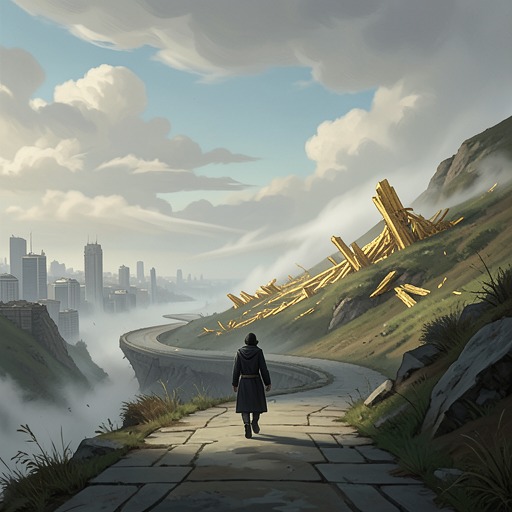
The later reflection on Algiers places the city within a broader need for modern deserts. There are no longer literal deserts or islands sufficient for withdrawal, yet people still require distance from the world in order to understand it and temporary solitude in order to serve others better. Big cities can provide that solitude, but only under particular conditions. European cities are saturated with the noise of their past—the revolutions, empires, fame, and accumulated memories that prevent sufficient silence.
Algiers supplies a different kind of retreat. Its solitude is not created by empty wilderness but by the concentration of elemental realities: sea, stone, sky, heat, flesh, and the human creature. The city can function as a place where the mind is not uplifted by cultural memory and therefore cannot easily evade itself. Its spiritual value lies precisely in the absence of attractions that might offer an inherited meaning.
The city’s relationship to permanence is consequently double. Its inhabitants wall themselves away from the landscape, while beyond the walls land and sea continue their indifferent dialogue. Nature first interests, then bores, and finally prevails through persistence. Algiers may try to close the window on beauty, but the world remains outside, patient and unconcerned. The city’s deepest lesson is that neither human boredom nor human enclosure can finally cancel the permanence of the natural world.
Historical and Existential Contrast
Algiers also stands against the modern tendency to locate consciousness exclusively in large urban history. Modern philosophy and literature are criticized for turning away from nature, the sea, hilltops, and evening meditation, as though consciousness existed only in streets and history only in political movement. Against that reduction, Algiers restores the elements that historical thinking excludes. Its sea and sky are not decorative scenery; they challenge the belief that human meaning can be contained by history and power alone.
The city’s significance therefore exceeds local affection. It offers an image of culture grounded not in transcendence or accumulated tradition but in the difficult coexistence of natural beauty, bodily intensity, poverty, and death. Between the sky and the faces beneath it there is no mythology ready to console the inhabitants. There are only tangible things, and the lucidity required to live among them.